- About Us
- News
- Our Clients
- Business Clients
- Medical Practices
- Ambulatory Surgery Centers
- Plastic Surgeons
- Dermatologists
- Skilled Nursing Facilities & Long Term Care Providers
- Assisted Living Facilities
- Dentists & Oral Surgeons
- Physical Therapists
- Chiropractors
- Acupuncturists
- Massage Therapists
- Pharmacies
- Laboratories
- Diagnostic Imaging Centers
- Veterinary Practices
- Our Services
- Fractional General Counsel Services
- Commercial Litigation & Dispute Resolution
- Contracts & Agreements
- Entity Formation & Corporate Governance Advisory
- Employment & Labor Law Solutions
- Private Equity
- Corporate & Healthcare Strategic Transactions
- Commercial Real Estate & Finance
- Mergers, Acquisitions & Divestitures (M&A)
- Regulatory Compliance & Enforcement Advisory
- Government Investigations & Audits
- Strategic Business & Healthcare Practice Consulting
- Inquiries/FAQs
- Contact Us
GLP-1 / Peptide / Telehealth Platform
GLP-1 · Peptides · Telehealth · Compounding
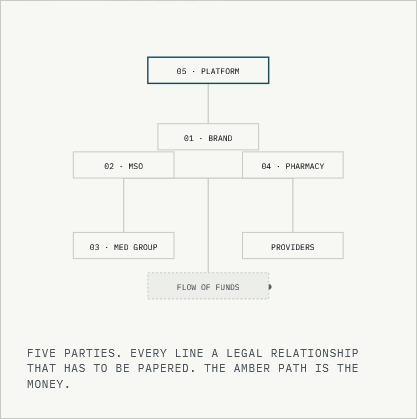
Every side of this deal has been built here.
- 01The brand and storefront
- 02 The management company
- 03 The medical group
- 04 The pharmacy
- 05 The platform that assembles all four
Our firm advises telehealth and compounding companies across the country, and we have built for every seat at this table. We have drafted the agreements that connect the parties, written the terms, privacy, and consent that run the storefronts, mapped the money that moves between them, structured the visits and supervision behind the care, and answered the letters when regulators came asking. GLP-1, peptides, hair loss, hormones, ED. Whichever seat you hold, we have almost certainly built the one across from you.
$0B+
Combined annual client sales in telehealth
0 seats
In the structure represented
0 states
Corporate practice, prescribing & licensing mapped
Every doc
Between the patient's payment and the pharmacy's shelf
We advise across:
GLP-1 & weight loss
Peptides
Hair loss
Male hormones / TRT
Erectile dysfunction
Sexual health
Longevity & wellness
Adjacent DTC categories
Find your seat One of these five seats is yours.
One of these five seats is yours.
The other four are where your risk hides.
Here is what almost no one tells you: this entire industry runs on a five-party structure, and each seat carries legal exposure the others never see. The agreements that connect them get drafted by whoever holds the most leverage, which means someone at the table always signs paper that was never written with their interests in mind. Find your seat below and you will see, in plain terms, exactly what we do to protect your side of the deal, and where the danger sits on every side you are not watching.
You run the storefront
You own the brand, the site, the marketing, and the customer. You do not practice medicine and you do not dispense, and every word on your website has to hold that line while still selling. There is very little margin in that sentence, and the FDA has spent the last year proving it.
Website & product pages
- Full site audit with deploy-ready replacement copy
- Product page drafting across the formulary
- Trademark misuse cleanup
- Supplement disclaimers removed from Rx products
- FAQ and educational content
Checkout & subscription
- Screen-by-screen checkout text and disclosures
- Consent checkbox language and placement
- Membership architecture
- ROSCA and state auto-renewal compliance
- Cancellation flow and policy
Advertising & media review
- Pre-publication review of every ad, every channel
- Influencer and testimonial compliance systems
- Media buy and advertising order redlines
- FTC claims substantiation files
- LegitScript strategy and platform ad policy
- Documented ad approval workflow
Payments & processing
- Merchant and payment processor agreements (including Stripe and other major processors)
- Merchant-of-record structuring
- Collection agent and collections agreements
- Compliant payment structures for the model
- Subscription and recurring billing terms
- Reserve, chargeback, and MATCH exposure
- KYC and high-risk merchant onboarding
Fulfillment & vendors
- Fulfillment and 3PL agreements
- Pharmacy and medical group agreements from your side
- Technology, hosting, and software vendor agreements
- Agency and marketing vendor agreements
Website legal & policies
- Terms of Service / Terms of Use drafting
- Privacy Policy drafting
- SMS and text message consent (TCPA)
- Email consent and CAN-SPAM language
- Cookie and tracking disclosures
- Notice of Privacy Practices
- Accessibility and returns/refund policies
Privacy & data
- Washington MHMDA and state health data laws
- BAAs with every data-touching vendor
- Tracking pixel exposure on health pages
- Consent capture and audit trail
- Breach response planning
Corporate & operating
- Entity formation and multi-state registration
- Trademark clearance and enforcement
- Governance, raises, employment
- Mass arbitration exposure in the terms
When something goes wrong
- FDA warning letter responses
- FTC inquiries and CIDs
- Website and regulator audit responses
- LegitScript denials; ad suspension appeals
- Processor termination and manufacturer demands
You walk away with
A site you can advertise, a checkout that survives an FTC read, payment and fulfillment relationships that hold, and an approval process that means nothing ships without clearance.
You run the MSO
You hold the economics without owning the medicine, and the entire structure depends on that line staying clean. We have structured management services organizations operating across many states and many brand relationships, from single-brand groups to enterprise, multi-entity platforms.
Entity architecture
- MSO formation and structure design
- Multi-tier holding structures
- Foreign qualification in every operating state
- Launch and expansion sequencing
Management services agreements
- MSA drafting and negotiation at enterprise scale
- Fee structures built for fair market value
- Percentage-of-revenue analysis by state
- Scope, term, and transition provisions
- Successor and assignment mechanics for a future deal
Corporate practice
- Fifty-state CPOM mapping against your docs
- Which states your current structure fails
- 2025-2026 tightening (California, Oregon)
- Control allocation and governance proof
Intercompany paper
- Cost allocation and shared services
- Employee leasing agreements
- Trademark and IP licenses between entities
- Joinder mechanics for new subsidiaries
Vendor & payment agreements
- Payment processor and merchant agreements
- Billing and collection agent agreements (MSO-to-PC)
- Merchant-of-record and compliant payment structures
- Technology, EHR, and platform vendor agreements
- Marketing, call center, and BPO agreements
- Fulfillment and logistics coordination
Money & privacy chain
- Flow of funds analysis across entities
- AKS, fee-splitting, patient brokering review
- MSO-as-business-associate mapping
- Subcontractor BAAs and flow-down
Transactions & capital
- Buy-side and sell-side M&A
- Diligence questionnaires for telehealth targets
- Pre-transaction readiness and cleanup
- PE-backed structuring and roll-ups
Defense & audits
- Regulator and payor audit responses
- State CPOM inquiries directed at the structure
- FTC and state AG inquiries
- Counterparty and partner disputes
You walk away with
A structure investors can diligence, fees you can defend, vendor and payment agreements that hold, and a documented line between what you manage and what you do not.
You own the medical group
You hold the license, the patient relationship, and the liability. When a board opens a file, it opens on you, not on the platform that sent the patient. We have formed and papered professional entities and provider networks operating across many states. Your protection is documentation, and documentation is exactly what platform-built intake flows tend to skip.
Entity & ownership
- Professional entity formation by state
- Friendly PC structuring
- Succession and transfer restriction agreements
- Genuine physician-control governance
Providers & supervision
- Physician and contractor agreements
- Physician supervision requirements by state
- NP and PA collaborative practice agreements
- Autonomous / independent practice states
- Delegation, protocols, and standing orders
- Compensation without fee-splitting exposure
- Non-compete enforceability by state
Consent & clinical documentation
- State-specific telehealth informed consent
- Treatment- and category-specific consent forms (GLP-1, hormones, ED, peptides)
- Compounding and significant-difference consent addenda
- Consent forms developed for each party in the model
- 503A attestation templates that hold
- Prescreening integrated into intake
- Prescription template review
Visit modality & prescribing
- Synchronous (live video) visit structuring
- Asynchronous (store-and-forward) visit structuring
- Which states permit which modality, by category
- Establishing the provider-patient relationship
- Fifty-state prescribing rules
- Controlled-substance considerations (e.g., testosterone)
- Multi-state expansion sequencing
Records & privacy
- Record ownership stays with the group
- Custody on termination
- BAAs with MSO, platform, and vendors
- HIPAA program and breach response
Defense & risk
- Medical board complaint responses
- Licensure defense coordination
- Malpractice claim coordination
- Telehealth and multi-state coverage review
You walk away with
Consent and attestation systems that hold up under review, provider agreements that match your state footprint, and separation from the MSO that a regulator can see.
You own the pharmacy
Enforcement reaches you first and hardest. The shortage window closed, the essentially-a-copy analysis got harder, and the marketing your brand partners run can create exposure on your side of the wall even though you are prohibited from doing much of it yourself.
Regulatory posture
- 503A and 503B status analysis
- Establishing the clinically significant difference exception, product by product
- Documenting the exception so it holds under review
- The regularity threshold
- Bulks list categorization
- How FDA rulings and PCAC panel recommendations affect your formulary
- Post-shortage strategy
Formulary review
- Semaglutide, tirzepatide, microdosing
- NAD+, sermorelin, glutathione, hormones
- Peptides inside and outside lawful compounding
- Sildenafil/tadalafil where generics exist
- “Research use only” exposure
Advertising restrictions
- The 353a(c) promotion prohibition
- Where partners’ marketing reaches you
- Contract language building the wall
- What your own materials may say
Network & money
- Network access and fulfillment agreements
- No per-prescription payments to platforms
- Patient volume guarantee analysis
- Fair market value dispensing fees
- Brand partner KYC screening
Fulfillment & supply chain
- Cold chain and shipping agreements
- 3PL and logistics terms
- API sourcing and import considerations
- Nonresident licensing in every ship-to state
- Cross-state shipment analysis
Defense & enforcement
- FDA Form 483 responses
- Warning letters and corrective action plans
- State board inspections and audits
- Nonresident license actions; recall coordination
You walk away with
A defensible regulatory file, agreements that do not create referral exposure, a fulfillment chain that is licensed and papered, and a screening process that keeps bad partners off your line.
You sell the whole system
You are not running one business. You are supplying the machine that other people run: the provider network, the management layer, the technology, the pharmacy relationships. We have built complete turnkey enterprise stacks for platforms that license the structure to brand partners. Your product is the structure itself, which means your contract stack is the thing you are actually selling, and every prospect’s lawyer is going to read it.
The enterprise stack
- Management and collection agreements
- Platform and software licenses
- Network subcontractor agreements
- Intercompany agreements with cost allocation
- Role-calibrated BAAs and NDAs
Partner-deployable templates
- Terms of service templates
- Privacy and NPP templates
- Telehealth consent and addenda
- Cancellation and refund policies
- Influencer and affiliate agreements
Multi-entity architecture
- Holding company with separated functions
- Multi-state formation and registration
- Joinder mechanics for brands and states
- Template governance at scale
Brand onboarding
- Permitted / restricted / prohibited taxonomy
- KYC and diligence question sets
- Onboarding agreement packages
- Partner file audit protocols
Payment & fulfillment infrastructure
- Processor and merchant agreements for the network
- Fulfillment, 3PL, and pharmacy network terms
- Revenue flow across brands and entities
- Fair market value across the whole stack
Franchise screening
- Whether license + system + fee triggers franchise law
- Business opportunity statute analysis
- Structuring to stay outside registration
Corporate & transactional
- Governance, raises, investor docs
- Trademark portfolio
- Multi-state employment
- M&A on both sides
Defense across the network
- FDA and FTC response coordination
- Regulator audit response
- Brand partner incident management
- Manufacturer demand response
You walk away with
A contract stack clean enough that your prospects’ counsel approves it, which is itself a sales advantage, a payment and fulfillment layer that scales, and an onboarding process built to add brands and states without rebuilding.
The vendors, the money, and the data between everyone
Not every party sits in a defined seat. Some of the highest-exposure relationships live in the space between them: the marketing partners, the affiliates, the processors, the fulfillment vendors, and the flow of money and data through all of it.
Marketing & media partners
- Pre-publication review of every ad and post
- Media buy and advertising order redlines
- Agency and vendor agreements
- Lead generation boundaries
Affiliate compensation
- CPA, CPL, revenue share, per-signup analysis
- The line between advertising and referrals
- Restructuring into FMV advertising deals
- Affiliate agreements with compliance terms
Payments & processing
- Merchant and processor agreements (Stripe and others)
- Merchant-of-record analysis
- Collection agent and collections agreements
- Compliant payment flow structuring
- Chargeback, reserve, and MATCH disputes
- Re-underwriting after a shutdown
Fulfillment & logistics
- 3PL, cold chain, and shipping agreements
- Supplier and API sourcing terms
- Service level and liability allocation
The money map
- Every dollar traced through every party
- Each hop tested against AKS and state law
- Remediation with drafted replacement language
- Membership fee characterization
The data map
- Who is a business associate of whom
- Where every BAA and subcontractor BAA sits
- How PHI obligations flow down the chain
- Gap identification before a breach
You walk away with
A money flow and a data chain that are defensible at every hop, vendor and processor agreements that hold, and the documentation that proves it.
Whichever seat you sit in, our firm has done the work on the other side of the table.
Never in your matter, and every engagement clears a conflicts check first. But because we know how the paper gets drafted from the opposite direction, we know exactly where your agreement is going to hurt, and we fix it before it does.
Coverage matrix Find your column. Then count the
Find your column. Then count the
boxes you did not know you needed.
This is the whole practice on one grid: every service we offer, mapped against every seat in the structure. Run your finger down your own column and you will learn something most operators discover far too late, which is how many distinct areas of legal work their business actually touches. A solid mark is work we perform directly for you. A hollow mark is work that still reaches you through the structure, whether you planned for it or not.
Before the grid, here is how the deal is actually built.
The telehealth model deliberately separates the business of selling from the practice of medicine, because in most states a company that is not owned by licensed professionals may not own a medical practice or direct clinical decisions. That rule is the corporate practice of medicine doctrine, and it is the reason the structure exists. Our job is to build it so that each party does only what it is permitted to do, and so that the agreements connecting them hold together when a regulator reads them side by side.
The storefront, or brand,
owns the customer relationship and the marketing, and typically collects the payment. It does not employ the physicians, own the medical group, or practice medicine. It engages the management company for non-clinical services through a platform or marketing services agreement.
The management services organization, or MSO,
supplies the non-clinical infrastructure: technology, marketing, administrative support, billing and collections, and day-to-day operations. It contracts with the medical group through a Management Services Agreement. That agreement must pay the MSO fair market value for services actually rendered, and it cannot give the MSO control over clinical decisions or a share of clinical fees, or the arrangement drifts into corporate practice and fee-splitting.
The professional corporation, or medical group (the PC),
is the licensed clinical entity. It is owned by licensed professionals, it employs or contracts the physicians and nurse practitioners, it holds the clinical relationship with the patient, and it issues the prescriptions. The PC signs the Management Services Agreement with the MSO and the clinical arrangements with its prescribers.
The pharmacy (503A or 503B)
dispenses the prescriptions. It typically contracts with the PC and its prescribers rather than with the storefront, so that nothing in the structure resembles paying for patient referrals. The clinically significant difference determination that supports a compounded prescription is made by the PC’s prescriber, not by the pharmacy or the brand.
The affiliate networks, vendors, and payment processors
are the connective tissue that moves patients, product, data, and money among the other four. Each of those flows is a place where a compliant structure can quietly become a non-compliant one, which is why they belong on the same map as everything else.
Three agreements hold the model together: the platform or services agreement between the storefront and the MSO, the Management Services Agreement between the MSO and the PC, and the pharmacy services arrangement between the PC and the pharmacy. Drafted as one connected system, the structure is defensible. Drafted separately by different lawyers who never compared them, the seams between the three documents are exactly where the money and the liability leak out. That is the problem this firm was built to solve, and the grid below shows every service that sits on top of it.
Service coverage by entity · The General Counsel Law Firm
Table Plugin Error
https://wordpress.org/plugins/advanced-custom-fields-table-field/
https://wordpress.org/plugins/advanced-custom-fields-table-field/
● Primary work performed directly ○ Touches this party through the structure — Not typically applicable
The Climate
This is what enforcement looks like right now.
Not a vague warning about regulatory risk. A plain account of what has been happening to companies in your exact business,
so you can see the wave before it reaches you.
1
FDA
The letters go out in waves.
Since September 2025, telehealth companies and compounders have received warning letters over compounded GLP-1 marketing, in batches large enough that the agency announces them by count. The citations barely vary: implying sameness with the approved drug, hiding who compounds it, and benefit claims that outrun the risk information.
2
Platform
The platform layer moves faster.
LegitScript gates advertising on the major platforms and can be revoked, including for missing a response deadline. Certification does not stop individual ad disapprovals, which stop spend the same day. And processors read the same signals regulators do. A terminated merchant account ends a business faster than any agency action.
3
Private
The quietest risk signed with you.
Boards open files on individual licensees, not on platforms, so a prescriber absorbs what the company did. Manufacturers have sued telehealth companies directly. And counterparties inside the structure sue each other, which is when a fee arrangement drafted three years ago gets read aloud by someone hostile to it.
Every one of these begins the same way: something that was written down turns out not to say what everyone assumed it said. That is the gap we close before it opens.
When the regulator calls
Every letter has a clock. We know each one.
When enforcement arrives, the first move decides how the whole thing ends. Our firm responds to the full range of federal, state, platform, and private enforcement that reaches companies in this industry. Here is what typically lands, what we do about it, and how fast it moves, because the clock is already running before most companies finish reading the letter.
Regulatory & enforcement response
Table Plugin Error
https://wordpress.org/plugins/advanced-custom-fields-table-field/
https://wordpress.org/plugins/advanced-custom-fields-table-field/
The difference
We were built inside the industry, not outside it.
Most healthcare firms learn this industry from the outside. They read the statute, they read the guidance, and they advise a client whose actual daily problem they have never lived. You can feel the gap in the advice.
Our firm was built the other way around. Our practice grew out of operational roles held inside healthcare companies, not only legal ones, so we approach your business the way an operator does. We have sat in the meetings where the legal answer collides with the launch date, where the compliant funnel converts worse than the one marketing wants to run, and where someone has to decide what the company is actually going to do on Tuesday. We have made that call, not just advised on it.
That operator’s instinct, paired with a genuine command of unit economics, capital structure, and what a business can actually survive, is what we bring to your structure. It is why our work is built to be run, not just to be filed, and it is why our clients keep us close as they scale.
Across enterprise engagements spanning every seat in the telehealth structure, and the representation of clients whose combined annual sales in the telemedicine space exceed one billion dollars, serving as management services organizations, professional corporations, pharmacies, storefronts, and affiliate networks, we hold to one idea: legal work a business cannot operate is not finished work.
“The compliant version has to be the version you can actually run. Otherwise nobody runs it.”
Operational readiness Growth outran the paperwork.
Growth outran the paperwork.
We build the base back under a running company.
A lot of companies in this space grew faster than anyone planned for. Revenue, headcount, states, vendors, and product lines multiplied in a matter of months, and the foundation never got built to match. The healthcare-regulatory piece is only part of it. The whole company outgrew its base at once, and the gaps stay quiet right up until the day one of them is not.
We build the entire operational and compliance foundation, across every part of your company, not only the parts that touch a prescription. Then we stand up a working cadence that actually gets it done.
Whole-company compliance program
A written program with policies, SOPs, owners, and a documentation calendar covering every function, not only the clinical one.
Vendor diligence & management
Onboarding, KYC, risk tiering, contract standards, and ongoing oversight for the vendors, processors, and partners across the business.
HR & employment
Employment and contractor agreements, worker classification across states, handbooks, onboarding, and the policies a fast-scaling team needs.
Licensing & registrations
Entity, professional, and pharmacy licensing, foreign qualification, and the registrations that have to exist in every state you operate in.
Corporate & governance
A clean entity structure, governance, equity and cap-table hygiene, and the intercompany paper a future investor or buyer will read.
Data, privacy & security
The HIPAA and state health-data program, the business associate chain, and data practices that scaled past their own controls.
Security safeguards & access
The administrative, physical, and technical safeguards your data obligations require, offboarding that revokes a former employee’s access on day one, and networks configured to be secured rather than assumed to be.
Insurance & coverage
Determining the insurance the business actually needs as it scales, and drafting the coverage requirements into every agreement so your counterparties carry theirs too.
Money & financial controls
Flow-of-funds discipline, fee structures, and the controls that keep payments and compensation defensible as volume grows.
Marketing & advertising
The review workflow, substantiation discipline, and partner and affiliate standards a growing marketing engine needs built in.
Enforcement readiness
Incident and response playbooks, so the first regulator letter meets a company that already knows what to do.
We do it on a cadence, not in a memo.
Foundations do not get built by a document that lands in an inbox. They get built by showing up, week after week, until the company is where it needs to be. We run standing working sessions, weekly or several times a week depending on how far behind the growth got, each with a defined agenda, assigned owners, and deadlines.
- An assessment of where the company actually stands across every function.
- A prioritized roadmap, sequenced by risk and by what unblocks the business.
- Standing weekly or multi-weekly working sessions that move items from open to closed.
- Documentation produced as we go, so the foundation is provable, not just discussed.
- A steady state where the company is current, and staying current becomes routine.
The full range Twenty ways this business gets people in trouble.
Twenty ways this business gets people in trouble.
We handle all twenty.
Every one of these is a real way a GLP-1, peptide, or telehealth platform runs into a wall, and every one is something we do. Open the ones that apply to you and see exactly how we handle it, in your language, not a statute’s.
Telehealth platform structuring
+
-
MSO and professional entity design, friendly PC formation, fifty-state corporate practice mapping, and multi-tier holding architectures with separated network, management, and technology functions.
MSO & management services agreements
+
-
Management services agreements drafted and negotiated from single-brand groups to enterprise, multi-entity platforms: fair-market-value fee structures, scope and control boundaries, intercompany and collection agreements, and successor mechanics for a future transaction.
Turnkey & white label enterprise builds
+
-
The complete integrated contract stack that makes a system sellable: management agreements, platform licenses, network subcontractor agreements, intercompany agreements, brand onboarding frameworks, deployable partner templates, and joinder mechanics for scale.
Entity formation & multi-state registration
+
-
Entity selection by seat and by state, professional entity rules, foreign qualification everywhere services run, and launch sequencing that keeps every state lawful before it goes live.
Flow of funds design & remediation
+
-
Every dollar traced from patient through platform, MSO, medical group, pharmacy, and marketing partners, tested against the Anti-Kickback Statute, state fee-splitting, patient brokering, and CPOM fee restrictions. Broken flows rebuilt.
Payments, processing, merchant of record & collections
+
-
Compliant payment structures for the whole model: merchant and payment processor agreements, including with Stripe and other major processors; merchant-of-record structuring; collection agent and collections agreements, including MSO-to-PC billing and collection; subscription and recurring billing terms; reserve, chargeback, and MATCH exposure; and KYC onboarding that keeps a high-risk healthcare merchant bankable.
Fulfillment, logistics & supply chain
+
-
Fulfillment and 3PL agreements, cold chain and shipping terms, supplier and API sourcing agreements, service-level and liability allocation, and the nonresident and cross-state considerations that ride along with them.
GLP-1 & peptide compounding compliance
+
-
503A and 503B analysis, establishing and documenting the clinically significant difference exception product by product, prescriber attestation infrastructure, formulary-wide product legality review, and post-shortage strategy. We advise every party in the model on how FDA rulings and recent advisory panel (PCAC) recommendations change what can be compounded and offered.
Product & formulary expansion
+
-
Advising on where and how to expand product offerings compliantly across GLP-1, peptides, hair loss, hormones, ED, and adjacent categories: the regulatory basis for each new product, the visit modality and consent it requires, the compounding or sourcing path, and the marketing and payment implications, mapped against the states you serve before you launch it.
Advertising, media review & website audits
+
-
Pre-publication review of every ad on every channel, full website audits with deploy-ready copy, influencer and testimonial systems, LegitScript strategy, media buy redlines, and the internal approval workflow that documents it.
Affiliate & influencer program compliance
+
-
Building affiliate and influencer programs that drive growth without crossing into paying for patients: CPA, CPL, revenue-share, and per-signup structures analyzed against the line between advertising and referrals, affiliate and influencer agreements with disclosure and substantiation obligations built in, network and sub-affiliate terms, and restructuring of arrangements that read as fee-splitting into fair-market-value advertising deals.
Website drafting, terms, privacy & SMS consent
+
-
We draft the site, not just audit it: product pages, checkout flows, Terms of Service, Privacy Policy, notice of privacy practices, SMS and text consent (TCPA), email consent (CAN-SPAM), cookie and tracking disclosures, auto-renewal and refund policies, and tracking technology exposure on health data pages.
Visit modality, supervision & collaborative agreements
+
-
Synchronous (live video) versus asynchronous (store-and-forward) visit structuring by state and by treatment category, physician supervision requirements, autonomous and independent nurse practitioner practice states, collaborative practice agreements, delegation, protocols, and standing orders, and the modality and prescribing rules that differ across GLP-1, hormone, ED, and controlled-substance categories.
Consent forms across the model
+
-
Consent developed for every party that needs it, not just the medical group: state-specific telehealth informed consent, treatment- and category-specific consent for GLP-1, hormones, ED, and peptides, compounding and significant-difference consent addenda, and the data, SMS, and marketing consent the storefront relies on. Built to match the intake, the structure, and the states you serve.
Pharmacy, network & vendor contracting
+
-
Network access agreements, provider network agreements, fulfillment terms, vendor and technology agreements, and the multi-party fee architecture that connects them.
HIPAA, privacy & the business associate map
+
-
Who needs a business associate agreement and why, subcontractor chains, breach response, state consumer health data laws including Washington’s My Health My Data Act, and Security Rule readiness.
Compliance programs, insurance & security safeguards
+
-
Written policy suites, audit protocols, partner file audits, KYC frameworks, and attestation and consent capture systems; insurance guidance, including coverage requirements drafted into every agreement; and the security posture a scaling company needs, meaning administrative, physical, and technical safeguards, employee offboarding that revokes access on day one, and secured network configuration.
Healthcare M&A, investment & diligence
+
-
Buy-side and sell-side transactions, diligence questionnaires purpose-built for telehealth and GLP-1 targets, pre-transaction readiness, and structure cleanup before a buyer sees the data room.
Regulatory response, defense & audits
+
-
FDA warning letter and Form 483 responses, FTC inquiries and CIDs, LegitScript revocations, ad platform appeals, processor terminations, board complaints, state AG inquiries, regulator and payor audit responses, manufacturer demands, and counterparty disputes.
The operating company layer
+
-
Governance and capital raises, multi-state employment and contractor classification, trademarks and IP, commercial and logistics contracts, text and email marketing compliance, and franchise law screening for turnkey models.
Or hand us the whole thing, ongoing.
At some point a growing company stops needing a lawyer it calls when something breaks and starts needing one who already knows the business well enough to see the break coming. That is fractional general counsel, and it is the same senior judgment an in-house GC would give you, without the cost of building the seat.
One relationship, covering the whole company. The structure, the contracts, the payments and collections, and every marketing element from ad review to influencer and affiliate programs to the claims your team wants to make. The operational calls a GC is expected to weigh in on: vendor diligence, HR and employment, licensing and registrations, governance, and the response when a regulator writes. Determining the insurance the business actually needs, and getting the coverage requirements written into the agreements so your counterparties carry theirs too. And the security posture that most fast-growing companies never formalize: the administrative, physical, and technical safeguards your data obligations require, offboarding that actually revokes a former employee’s access on their last day rather than months later, and networks configured to be secured rather than assumed to be. Held together by a standing weekly or multi-weekly cadence, so the work moves on a schedule instead of waiting for a crisis. You get the firm that built it keeping it current. Where a matter runs beyond this practice, we bring in specialist or local counsel and tell you so at the start, not after.
Productized
Defined scope. Known deliverable. A fee you agree to first.
You buy software on a defined scope. You buy agencies on a defined scope. Then you reach legal and get handed a meter with no ceiling and an invoice you cannot predict. That is backwards, and we do not run the practice that way. Everything below is a defined engagement with a stated deliverable set, drawn from work we have performed for platforms, management companies, medical groups, and pharmacies in this exact industry. You choose how you pay for it: a flat fee on a fixed scope, an hourly rate where the work genuinely cannot be scoped in advance, or a hybrid that caps the parts we can define and meters only the parts we cannot. The fee is agreed before the work begins, not discovered on a statement.
Build it
The Launch Package
Fixed-scope engagementThis is the complete legal foundation a new platform needs in place before it accepts its first order. We form and register the entity across the states you intend to serve, draft the professional entity together with its succession documents, and prepare the management services agreement, the core contract stack, the informed consent forms, the policy suite, and the business associate agreements the model requires. We then paper your payment and fulfillment agreements, design the insurance architecture around the business, and deliver a launch sequencing memorandum that sets out the order in which each piece should be turned on.
A launch has a date on the calendar, and a company preparing for one deserves a defined scope and a fee it can plan around rather than an open-ended hourly engagement that offers neither.
The Turnkey Stack
Fixed-scope engagementThis is the complete enterprise suite for white label and turnkey platforms, drafted as a single connected system rather than a folder of unrelated forms. It includes the management and collection agreements, the licenses, the subcontractor and intercompany agreements with their joinders, the business associate agreements, the customer-facing templates your operators deploy, the payment and fulfillment infrastructure, the onboarding framework, and a franchise-law screening of the entire arrangement.
Your prospects will hand this stack to their own counsel before they sign, so it should be the document that earns their confidence rather than the one that gives them a reason to hesitate.
Run it
The 503A Compliance System
Fixed-scope engagementThis system builds the documentation that must exist behind every compounded prescription you offer. We prepare per-product regulatory memoranda across your formulary, draft the prescriber attestation templates and the patient consent addendum, assemble the prescreening set, review the legality of each peptide you intend to carry, and put in place the documentation protocol that keeps the record defensible as your formulary changes.
When an investigator arrives, he does not ask what your lawyer advised; he asks what your files contain, and this is the engagement that makes certain they hold the right answer.
The Website & Checkout Build
Fixed-scope engagementThis engagement rebuilds the language of your storefront so that what your customers read is both persuasive and defensible. We deliver line-by-line replacement copy across the formulary and screen-by-screen checkout text, structure the membership and auto-renewal terms to satisfy the subscription laws that apply, refresh the policy suite, review the tracking pixels, and compile a claim substantiation file that supports every representation the site makes.
Most legal reviews hand marketing a memorandum it cannot use, whereas this engagement hands the team finished language it can paste directly into the site.
The Money Map
Fixed-scope engagementThis is a complete visual map of every dollar as it moves through every party in your structure, with each transfer tested against the Anti-Kickback Statute, the prohibitions on fee-splitting and patient brokering, and the corporate-practice-of-medicine fee restrictions that apply in the states you operate in. Wherever a transfer fails one of those tests, we deliver drafted remediation to bring it back into line.
Fee-splitting problems are rarely visible in any single agreement, and they tend to surface only when every agreement is laid on the same table and read together, which is precisely what this engagement does.
The Operational Foundation
Ongoing engagementThis is a whole-company buildout for teams that grew faster than their base. We construct the compliance program, the vendor diligence process, the HR and employment framework, the licensing and registrations, the corporate governance, the data practices, the insurance, the security safeguards and access controls, and the financial controls, and we do it through standing weekly or multi-weekly working sessions with assigned owners and deadlines until the company is fully current.
A foundation is built by showing up week after week and closing items on a schedule, not by a memorandum that lands in an inbox and is never acted upon.
The Compliance Program Suite
Fixed-scope engagementThis suite is the written compliance program itself, assembled as a complete and defensible body of work. It includes the written policies, the partner file audit protocols, the KYC and onboarding framework, the clinical template review, the breach response protocol, the training-ready materials, and the documentation calendar that keeps the program active rather than allowing it to sit unused on a shelf.
A written program is a defined deliverable with a defined table of contents, and it should be scoped and priced as one rather than billed by the hour.
The Ad Desk
Ongoing retainerThis is an ongoing pre-publication review desk for everything your marketing team ships, covering advertisements, landing pages, emails, influencer scripts, and affiliate creative. It comes with a stated turnaround commitment, a maintained substantiation file, a set of agreement templates, a LegitScript strategy, and support when a platform disapproves your account.
An advertising review billed by the hour is the review your marketing team will quietly skip under a deadline, which is the precise moment the review matters most.
The Regulatory Watch
Ongoing retainerThis is ongoing monitoring across the FDA, the FTC, the DEA, the state boards, and the courts, including a plain-language read on how FDA rulings and advisory committee recommendations, such as those of the PCAC, change what your business may compound, offer, and market. Every alert is written for operators rather than for lawyers, and the impact of each development is assessed against your specific structure.
Few operators think to call counsel to ask whether the law shifted this month, which is exactly why the companies without a watch in place tend to learn of a change only after it has already reached them.
Defend it. Sell it.
The Response Desk
Rapid response engagementThis is the engagement for the moment enforcement arrives. It delivers an immediate assessment and strategy, the drafted response filed within your deadline, a corrective action plan with owners and dates, remediation across your website, marketing, contracts, and documentation, and the closing record that memorializes how the matter was resolved. It covers FDA, FTC, LegitScript, platform, processor, board, audit, and manufacturer matters.
The first seventy-two hours after a letter arrives tend to determine how the entire matter resolves, which is why the work has to begin at once rather than after a leisurely scoping call.
The Diligence Kit
Fixed-scope engagementThis kit is built for diligence in a telehealth or GLP-1 transaction, whether you are acquiring, selling, or preparing to raise capital. It includes diligence questionnaires purpose-built for these targets, partner and vendor question sets, a pre-transaction readiness review run against your own business, and a findings memorandum that ranks every issue by its impact on the deal.
The questions that surface the real problems in this industry do not appear on any generic healthcare diligence checklist, and this engagement is built around the ones that do.
Flat fee, hourly, or hybrid, and quoted before the work begins.
Where a scope genuinely cannot be known in advance, which is rare, we say so at the outset and
agree on how it will be billed, rather than letting it surface on an invoice.
Not sure which one?
That is what the structure review is for. Thirty minutes, your actual structure, and a straight read on where it stands.
Engagements at scale
The shape of the work we do.
Your business stays yours, and so does everyone else’s. Client identities are confidential and always will be. What we can show you is the shape and scale of representative engagements, anonymized, so you can recognize your own situation in them.
Representative engagements, anonymized
Table Plugin Error
https://wordpress.org/plugins/advanced-custom-fields-table-field/
https://wordpress.org/plugins/advanced-custom-fields-table-field/
If yours looks like any of these, the conversation starts from a shorter distance.
The record
Depth, in numbers.
Clients whose combined annual sales in the telemedicine space exceed one billion dollars, representing management services organizations, professional corporations, pharmacies, storefronts, and affiliate networks. Enterprise contract stacks past 350 pages, drafted as single systems rather than assembled folders. Compliance programs past 300 pages. Corporate practice, prescribing, licensing, and consent requirements mapped across all fifty states. Product-level regulatory analysis across compounded GLP-1s, peptides, hormones, and longevity formularies. Payment, processing, and fulfillment agreements papered across the structure, and regulatory responses handled across the FDA, FTC, state board, platform, and processor landscape.
The General Counsel Law Firm, PLLC · Managing Partner Zach Simpson, Esq., EMBA · Florida Bar No. 112735 ·
Advising telehealth, compounding, and healthcare companies nationwide.
The reference material
The clearest explanations in the industry, free to read.
Most of the widely read guides in this space are not written by lawyers, which in a field where the entire question is what the law permits should give any operator pause. Ours are. Each one tells you what the rule says, what it means for how you actually run your business, and what to do on Monday morning. Educational, not legal advice, and written to make you smarter about your own company.
Questions
The questions you are already asking yourself.
Is compounded semaglutide still legal?
+
-
Compounding did not become illegal, but the shortage-based pathway that allowed large-scale compounding of copies ended in 2025. What remains lawful is patient-specific compounding supported by a documented clinical determination that the compounded product differs significantly from the approved drug for that patient. Price is not a significant difference. Neither is convenience or availability. The question is not whether compounded GLP-1 exists, it is whether the file behind each prescription would survive being read by someone looking for a problem.
Do I actually need an MSO?
+
-
If a non-physician owns economic interest in a business that delivers medical care, then in most states, yes, in some form. The harder question is whether the structure you have works in the states you actually serve. Single-state structures applied nationally are the most common defect we see, and the 2025 and 2026 legislative wave in states including California and Oregon narrowed the room considerably.
Can my pharmacy pay my platform per prescription?
+
-
This is the most consequential question in the industry and the answer is usually no. A payment that scales with prescription volume is tied to referrals, which is the core of anti-kickback and patient brokering analysis. Some state patient brokering statutes, including Florida’s, are not limited to federal program patients, so a cash-pay model does not by itself remove the exposure. The workable path is compensation for identifiable services at fair market value, set in advance, and not varying with referral volume. That restructuring has to happen before execution, not after a subpoena.
Can you help with a payment processor or Stripe agreement?
+
-
Yes. We review and negotiate merchant and payment processor agreements, including with major processors, along with merchant-of-record structures, subscription and recurring billing terms, reserve and chargeback provisions, and the know-your-customer onboarding that keeps a high-risk healthcare merchant bankable. Where a processor has terminated an account, we handle the response and the re-underwriting.
Do you handle fulfillment and payor agreements?
+
-
Yes. We paper fulfillment, 3PL, cold chain, and supplier agreements, pharmacy network access and dispensing terms, and the payment and processor relationships that move the money. These are drafted to fit the structure, so the fulfillment and payment layers do not quietly create referral, fee-splitting, or corporate-practice exposure.
We grew faster than we built our foundation. Where do we start?
+
-
This is one of the most common situations we are brought in for. A company scales faster than anyone planned, and the base never gets built to match: the compliance program, vendor diligence, HR and employment, licensing and registrations, governance, data practices, and financial controls all fall behind the growth at once. We build the whole-company operational and compliance foundation, not only the healthcare-regulatory piece, and we do it on a standing cadence, weekly or several times a week, with an assessment, a prioritized roadmap, assigned owners, and deadlines, until the company is current and staying current is routine.
How is the clinically significant difference exception established?
+
-
It is established one patient at a time, by the prescriber, and recorded in documentation that reflects a real clinical judgment rather than a policy applied to everyone. The determination is that the compounded product is significantly different from the approved drug for that particular patient, for a clinical reason. Price, convenience, and availability do not count. We advise the medical group and the pharmacy on how to establish the exception, builds the attestation so it can be answered both ways, and structures the intake so the prescriber is deciding on real information. Done correctly, the file behind each prescription tells a coherent, patient-specific story.
How do recent FDA rulings and the PCAC panel affect my business?
+
-
They change what can lawfully be compounded, offered, and marketed, and they affect every party in the model, not only the pharmacy. FDA shortage resolutions and bulks proposals narrowed the GLP-1 compounding pathways, while the July 2026 advisory committee recommended several peptides for the 503A bulks list, a recommendation that is not yet a rule. We advise each party on what these developments actually mean for its formulary, its marketing, and its structure, and separates what has legally changed from what has only been proposed or recommended, because acting on the second as if it were the first is how businesses get ahead of the law.
Can you help us expand our product offerings?
+
-
Yes. Before you add a product, whether it is a new peptide, a hormone, an ED or hair loss offering, or an adjacent category, we map the regulatory basis for it, the visit modality and consent it requires, the compounding or sourcing path, and the marketing and payment implications, against every state you serve. Product expansion is where fast-growing platforms most often add exposure without realizing it, because a new SKU can carry a different modality rule, a different compounding basis, and a different advertising constraint than the one it sits next to.
Do you draft website terms, privacy policies, and SMS consent?
+
-
Yes. We draft the full website legal layer for telehealth brands: Terms of Service, Privacy Policy, notice of privacy practices, SMS and text message consent built for TCPA, email consent for CAN-SPAM, cookie and tracking disclosures, and auto-renewal, cancellation, and refund policies. For a prescription healthcare storefront these are not generic templates; they have to match the structure, the consent capture, and the state health data laws that apply.
How do the ongoing weekly meetings work?
+
-
Foundations do not get built by a memo. For buildout and fractional general counsel engagements, we run standing working sessions, weekly or multiple times a week depending on how far behind the growth got, each with a defined agenda, owners, and deadlines. Items move from open to closed on a schedule, documentation is produced as the work happens, and the company reaches a steady state where it is current across every function rather than reacting to problems one at a time.
Do you advise on synchronous versus asynchronous visits and supervision?
+
-
Yes, and it is one of the more consequential design questions in telehealth. We advise on synchronous (live video) versus asynchronous (store-and-forward) visit structuring, which the states permit differently by treatment category, on physician supervision requirements, on autonomous and independent nurse practitioner practice states, and on collaborative practice agreements, delegation, protocols, and standing orders. The right modality and supervision model depends on the states you serve and the category you are treating, including where controlled substances such as testosterone are involved.
Which of my vendors need a business associate agreement?
+
-
Any vendor that creates, receives, maintains, or transmits protected health information on your behalf. The chain runs further than most operators expect. A management company handling administrative functions for a medical group is typically a business associate of that group, which makes its own data-touching vendors subcontractors, whose obligations must flow down no less protectively. Most platforms discover the gap during a breach, the worst possible moment to map it.
Can my compounding pharmacy advertise the drugs it compounds?
+
-
Federal law restricts advertising and promotion of specific compounded drug products, which surprises many pharmacies and nearly every brand partner. Marketing that a platform performs can create exposure on the pharmacy side even though the two are separate businesses. The wall between the pharmacy’s operations and the storefront’s marketing has to be built deliberately, in the contracts and in practice, not assumed.
Do my influencer posts need legal review?
+
-
Yes, and they carry more exposure than most operators assume. The FTC requires material connection disclosures that are actually visible, not truncated, and in video both seen and heard. Outcome claims and before-and-after imagery require typicality disclosure and substantiation. A prescription product adds a layer above the general endorsement rules, and recent FDA enforcement has focused on marketing that implies a compounded product is the same as an approved one.
What happens if I get an FDA warning letter?
+
-
You have a short window, typically fifteen working days, though the letter itself controls, and what you say shapes everything after it. The instinct to argue is usually wrong and the instinct to over-concede is worse. An effective response acknowledges specifically, corrects verifiably, and documents the correction, written knowing it becomes part of the public record. The remediation is usually broader than the letter: if three product pages are cited, the other forty need the same review before anyone answers.
Who owns the medical records in an MSO structure?
+
-
The medical group. This is not a preference, it is a structural requirement, and getting it wrong undermines the entire corporate practice defense. The management company can provide, host, and support the record system and access records as a business associate to perform its services. It cannot own them, and the agreements have to say so and mean it, including on termination, when the records must follow the practice rather than the platform.
What states restrict my structure?
+
-
Enough of them that the honest answer is that it depends on your model, and any lawyer who gives you a number without seeing your documents is guessing. Corporate practice doctrines vary from strict prohibition to near-permissiveness, fee restrictions differ independently, and telehealth prescribing and modality requirements form a third overlapping layer. The practical approach is a mapped analysis of your actual structure against every state you serve or intend to serve.
Does my white label platform trigger franchise laws?
+
-
Possibly, and almost nobody screens for it. State franchise and business opportunity statutes generally reach an arrangement combining a trademark license, a prescribed system or marketing plan, and a required fee. A turnkey telehealth offering can contain all three without anyone intending to sell a franchise. The consequences of an unregistered franchise offering are serious and include rescission rights. The screen is inexpensive; the discovery is not.
How do you charge?
+
-
On the model that fits the engagement, not the one that bills the most. We offer flat fees on a defined scope, so a project carries a number you agree to before it begins; an hourly rate where the work genuinely cannot be scoped in advance; and a hybrid that caps the parts we can define and meters only the parts we cannot. Ongoing support and fractional general counsel run on a standing retainer. Whichever model applies, the fee is agreed at the outset rather than discovered on an invoice.
Answers here are general and educational. Yours depends on your documents, your states, and your facts.
What to Expect
The moment you retain us, the guesswork ends.
Bringing on counsel should lower your stress, not add to it. Here is exactly what happens once you engage our firm, so you know what the first days look like before you commit to a single one of them.
1
The initial call
Shortly after you retain us, we get on a call together, and we listen before we talk. You walk us through the business as it actually runs today, not the tidy version. We map your structure, identify which of the seats you occupy, note the states you operate in, and flag the risks that cannot wait. You will never be judged for how the company got here. Most of the companies we help grew faster than their paperwork, and that is precisely the problem we are built to solve.
2
The documents we will ask for
To advise with precision rather than in generalities, we send a secure intake and request the records that show us how your business is actually built. The list is tailored to your seat, and typically includes:
- Entity and formation documents, and your cap table
- Your current contract stack: MSA, provider, pharmacy, and network agreements
- Vendor, affiliate, and marketing agreements
- Payment processor, merchant-of-record, and collections agreements
- Website copy, ad creative, and influencer materials
- Intake, consent, and prescriber attestation forms
- Your fee arrangements and flow of funds
- Any prior regulator, platform, or processor correspondence
- Current insurance policies
- The full list of states you serve or intend to serve
3
The strategy session
We come back to you with a mapped assessment, not a vague memo. You will see what holds, what does not, and what is urgent, laid against every state you operate in. From there we build a prioritized roadmap, sequenced by risk and by what unblocks the business fastest, with owners and timelines attached, and we match the engagement model, flat fee, hourly, or hybrid, to the work in front of us. You leave the session knowing your exposure, your plan, and your number.
4
What to expect moving forward
Then we execute. For buildout and fractional general counsel engagements, we run a standing weekly or multi-weekly working cadence, so the roadmap moves on a schedule instead of waiting for the next crisis. Documentation is produced as we go, so your foundation is provable rather than merely discussed. You always know what is finished, what is next, and what it costs, and you always have a direct line to the people doing the work. The goal is simple: a company that is current, defensible, and free to grow.
Start here
Start with the structure.
Almost everything that goes wrong in this industry was decided early, in a document nobody read closely, and discovered late, by someone with subpoena power. The fix is nearly always available at the beginning and almost never at the end. So start at the beginning. A structure review is a complimentary thirty minutes on your actual documents and your actual money flow, not a sales call with a legal veneer. You will walk away with a straight read on which parts of your structure hold, which parts do not, and the order to fix them in. And if you are already in good shape, we will tell you that too. Either way, you will know exactly where you stand, which is more than most companies in this space can say.
Email Zach@TheGeneral-Counsel.com directly Or